Our paper with Luke Rhee, “The Power and Limits of Distributed Representations in Strategic Decision Making,” has just been published in Strategy Science.
We tackle a fundamental organizational challenge: How can companies make better decisions by combining the partial insights of multiple specialists?
Think of it like landing a plane—neither pilot nor copilot has complete information, but together they succeed. We call these collective cognitive models distributed representations, and we develop a formal theory of when they help or hinder performance.
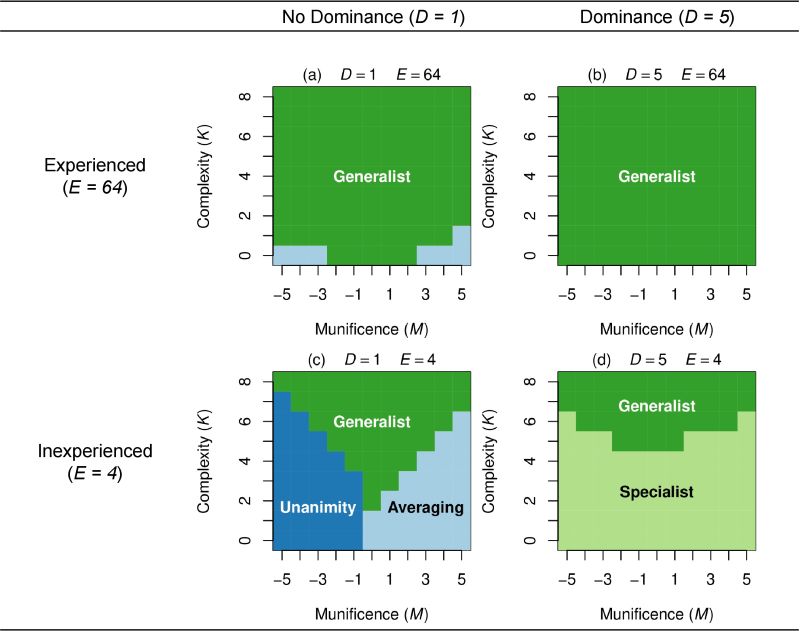
Key takeaways for designing decision processes:
Averaging delivers robust performance across most settings—a reliable default choice
Unanimity protects against errors when good opportunities are rare and managers lack experience
Specialists excel only when a single factor dominates (e.g., star power for blockbusters)
Experienced generalists can outperform all approaches—but they’re extremely scarce in practice
The core insight: There’s no universally “best” structure. Effectiveness depends critically on the three-way interaction between individual expertise, aggregation method, and environmental conditions (complexity, uncertainty, opportunity abundance).
Our framework extends Brunswik’s lens model and introduces “decision boundaries” from machine learning—bridging individual cognition and organizational structure, two research streams that have evolved separately for 60+ years.
This feels particularly relevant as organizations increasingly integrate AI into decision-making. Understanding human-AI distributed representations will be essential for designing effective hybrid systems.