Business schools have spent decades teaching students how to survive technological disruption. Now, we are the ones living inside the case study.
Generative AI can now match (and sometimes beat) human performance on the kinds of assignments business schools have long treated as core training. That should make management educators uncomfortable, not because students might outsource homework, but because it forces a sharper question:
If a tool can already do the work we use to signal competence, how exactly are we creating distinctive value?
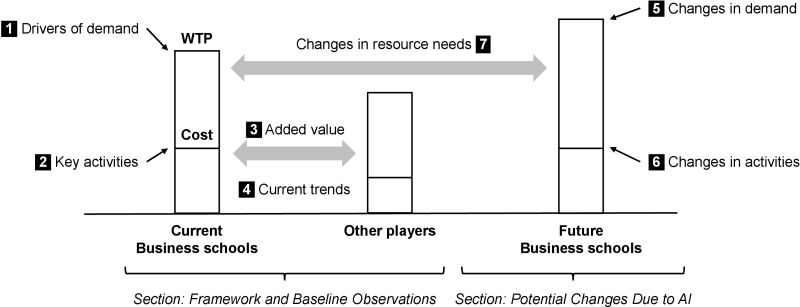
In a paper with Michael G. Jacobides and Peter Zemsky, we argue that management education may be approaching a “third epoch.”
The first (early 1900s) was practice-oriented: training professional managers for industrial firms. The second (post-1960s) was research-driven: importing rigor from economics, psychology, and quantitative methods. The third will be shaped by AI systems that can execute much of the analytical competence business schools teach.
We analyze this through a value-based strategy lens. A few implications:
The demand side is genuinely ambiguous.
AI could substitute for entry-level analytical labor and compress MBA ROI. Or it could increase the premium on people who frame problems, interrogate outputs, and lead adoption inside messy organizations. We don’t yet know which effect dominates.
Teaching shifts, not disappears.
As AI tutors improve, lecture-as-delivery looks fragile. But teaching moves toward instilling judgment on what to ask, how to challenge outputs, and how to create value with AI tools. Combine that with peer learning, identity formation, and teamwork under pressure. None of it automates cleanly.
Research is the strategic lever.
Business schools can study AI’s organizational consequences with fewer conflicts of interest than vendors or consultancies. If schools become the credible source of “what works” knowledge on human-AI collaboration, they defend and refresh their role.
The business model tension is real.
Teaching revenues have long subsidized research. If AI lowers the price of instruction or enables new competitors, schools need new ways to fund knowledge production.
The execution challenges are real: incentive systems that reward the wrong research, business models built on teaching revenues AI could disrupt, and EdTech competitors building AI-native from scratch while we retrofit.
But here’s what makes me optimistic: business schools have something no EdTech startup can replicate. The ability to conduct rigorous, conflict-free research on what actually works. If we do this well, we don’t just survive. We become more essential.
If you work in management education or hire from it, I’m curious: where do you think business schools will remain uniquely valuable when the “analysis” part gets cheap?