We just released a new working paper with my outstanding co-authors, Aticus Peterson and Daniel Wilde, that suggests the answer is yes.
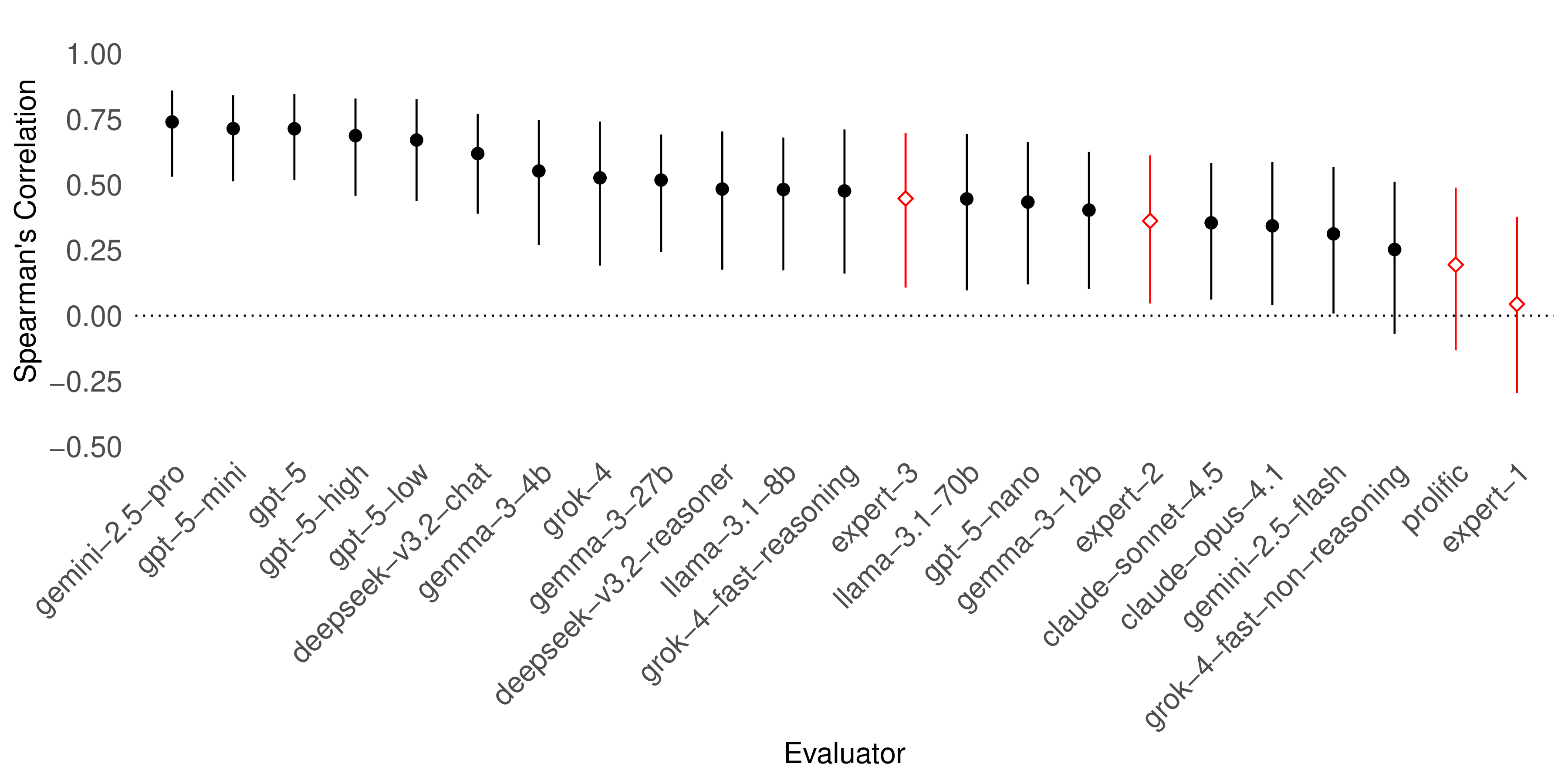
In a fully prospective tournament using live ventures, frontier AI models substantially outperformed human experts at predicting fundraising success.
The experiment
To ensure a fair test and avoid hindsight bias, we ran a fully prospective design. We selected 30 active Kickstarter technology projects launched after the training/knowledge cutoffs of all tested models, ensuring the projects were not in any model’s training data.
All predictions were registered while fundraising was still in progress. No model could have seen these projects during training.
We then asked a suite of LLMs and a group of 346 experienced managers (plus MBA-trained investors) to review identical, anonymized summaries and predict which ventures would raise the most funds.
The results
- The Humans: Achieved rank correlations with actual outcomes between 0.04 and 0.45.
- The AI: Several frontier models exceeded 0.60. The best model (Gemini 2.5 Pro) reached 0.74.
Put simply: The best AI correctly identified the winner in nearly 4 out of every 5 pairwise comparisons. The best human managed roughly 3 out of 5.
Why this matters
This isn’t just about crowdfunding. It touches on a core question in strategy: the ability to form accurate judgments about uncertain, high-stakes outcomes before they unfold.
For decades, we’ve assumed this kind of strategic foresight is a uniquely human trait dependent on intuition. Our results suggest that for specific evaluation tasks, AI may already be the superior forecaster.
Interestingly, we also found an “augmentation trap”: combining human and AI judgments actually reduced accuracy compared to the best AI model alone.
The paper
We are careful not to overclaim—this is one specific domain with standardized information. But the signal is strong.
A question for strategists and investors
If algorithms can screen opportunities with this level of accuracy, how does that change the role of the human investment committee? I’d love to hear your take.