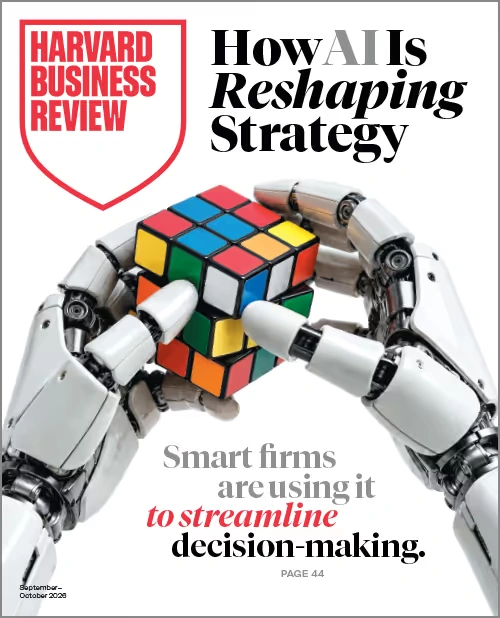
I’m glad to see my article, “AI is revolutionizing strategic decision-making,” published as the cover story of the September–October 2026 issue of Harvard Business Review.
Unbounding rationality
The article pulls together how I currently see AI changing strategic decision-making. I call the framework “unbounding rationality.”
Strategy has always been shaped by limits on human attention, memory, and processing capacity. AI does not remove those limits, but it can push them outward in three parts of strategic work:
- Search: generating and evaluating a much wider set of strategic options.
- Representation: building richer and more current models of customers, competitors, and markets.
- Aggregation: combining judgments and testing proposals without relying only on the dynamics of a meeting room.
From argument to practice
The article develops these ideas through examples—from M&A scouting and living market models to creator–critic workflows—and offers a practical playbook for redesigning strategy work. The central point is not simply that AI can make strategy faster. Used well, it can change which possibilities firms see, how they understand their environment, and how rigorously they challenge a proposed course of action.
The work behind the article
The article is single-authored, but it draws on years of joint work. I have been fortunate to work with many coauthors across my research. The following are the colleagues with whom I have coauthored work on AI-related topics:
Charles Ayoubi, Aaron Chatterji, James Evans, Teppo Felin, Paul Gouvard, Jessica Hullman, Michael G. Jacobides, Nan Jia, Harsh Ketkar, Hyunjin Kim, Karim R. Lakhani, Jacqueline N. Lane, Gwendolyn Lee, Aticus Peterson, Mari Sako, Tom Steinberger, Daniel Wilde, Peter Zemsky, and Todd Zenger.
I’m grateful to all of them for the ideas and conversations that shaped my thinking. I’m also grateful to the many scholars who contributed chapters to the Handbook of Artificial Intelligence and Strategy.
—