Our paper with Daniel Albert, “Search Heuristics Under Multiple Objectives: The Case of Corporate Social Responsibility,” is now online in the Academy of Management Review. We began writing it during COVID, so it took some time to get here.
Firms are often told to choose between doing well and doing good. But that framing usually assumes that they already know all their options. In practice, firms must search for them, and the rule used to evaluate each move affects what they will ever discover.
COVID gave us an intuition for this problem. Videoconferencing technology already existed, but most firms had not adopted it widely. When the pandemic forced health to the foreground, firms tried online meetings at scale. In the process, they discovered that many meetings could be held with less infection risk and at lower cost.
If firms were fully informed optimizers, they should have adopted those arrangements earlier. Search offers another explanation: changing priorities sent firms down a path they had not previously explored.
In the paper, we compare five ways of searching when both financial and social performance matter. The most surprising result concerns Alternate: pursue one objective until stuck, then switch to the other.
Alternating can dislodge a firm from a local financial peak and reveal an “oblique strategy”: one that performs better socially while matching or even exceeding the financial performance found by profit-only search. (We borrow the term from Brian Eno and Peter Schmidt, whose Oblique Strategies cards helped artists escape creative dead ends by approaching problems indirectly.) Sometimes the less direct route reaches a better destination.
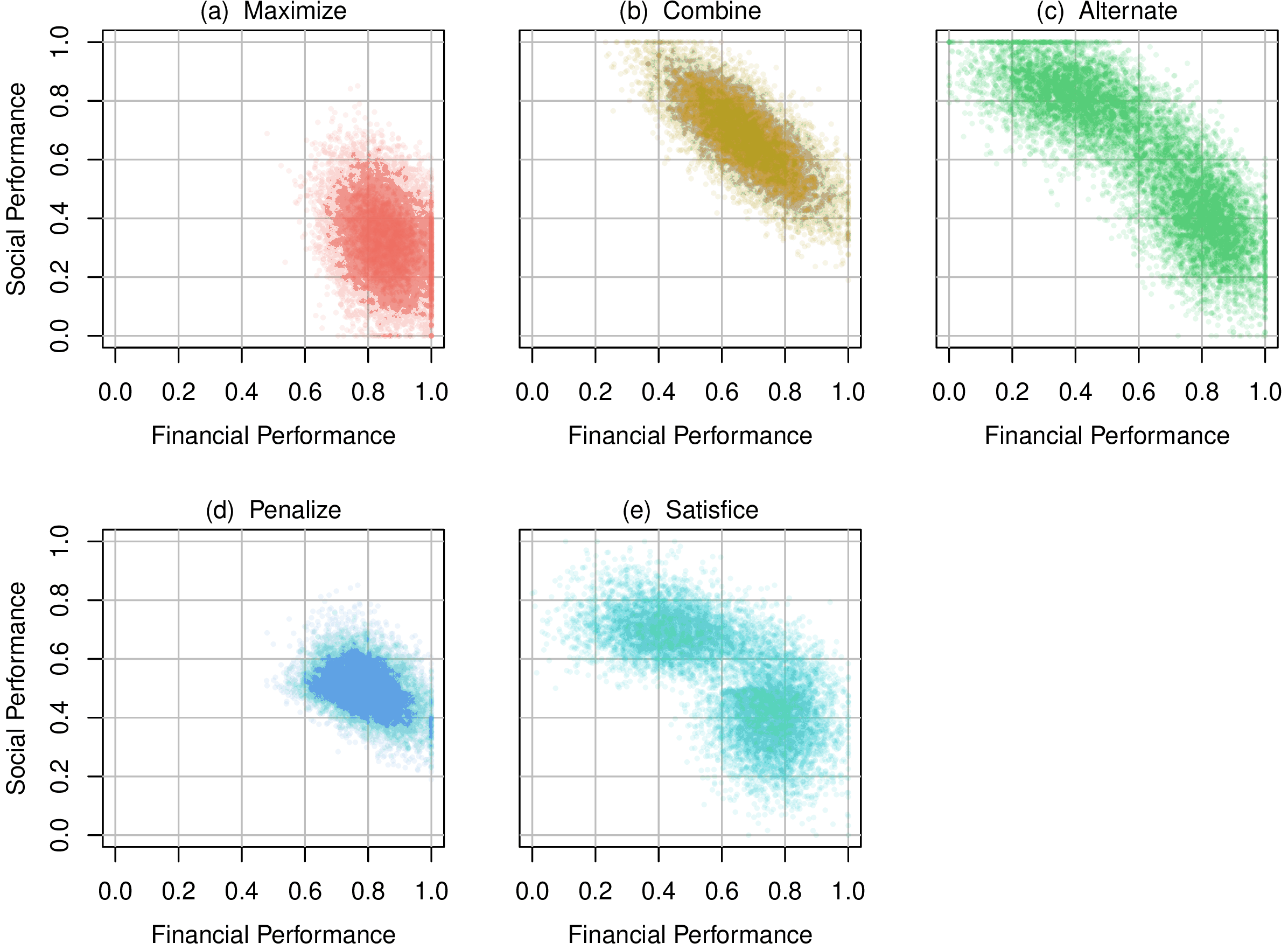
The evidence for Alternate is strong: in every environment we study, given enough time, alternating firms find strategies that do at least as well as profit-only search on both dimensions more than half of the time.
There is also a practical implication. Combining objectives requires putting social and financial value on a common scale. Alternating does not: a firm needs to know whether social performance is improving, but it does not need to assign that improvement a dollar value.
The broader lesson is simple: goals alone do not determine outcomes. Organizations also need a rule for pursuing them, and two firms with similar priorities can end up in very different places because they search differently.
An earlier version of the paper received the 2023 Distinguished Paper Award in Nonmarket Strategy from the Strategy Division of the Academy of Management.