Citation: Csaszar, F. A. (2026). Conceptual search: A generative view of entrepreneurial imagination. Strategic Entrepreneurship Journal (forthcoming).
Cite
Paper highlights
Entrepreneurs can pursue only the ventures they imagine. The Million Dollar Homepage sold advertising space one pixel at a time. Its technical ingredients had existed for years before Alex Tew assembled them into a business in 2005. What was missing was someone imagining how those ingredients could form a venture.
This paper develops a generative view of entrepreneurial imagination: the construction of an evolving candidate set through generation, provisional evaluation, and revision. It asks how possibilities enter consideration, survive, and develop before entrepreneurs commit resources. AI makes this usually hidden process observable and open to controlled experimentation.
Search over meaningful alternatives
Conceptual search represents alternatives as text and transforms them through rewrites and recombinations. Unlike the abstract bit strings of NK models, its positions and moves have substantive meaning: a change can alter a target customer or revenue model. Researchers can vary the search rules and trace how those choices change the possibilities that emerge.
The prototype searches over real crowdfunding venture concepts, using local refinement and a genetic algorithm for global recombination. A fidelity check prevents proposed improvements from becoming invented accomplishments. Scores measure promise under an evaluator previously validated against fundraising outcomes; the evolved ventures were not tested in the market.
What the prototype reveals
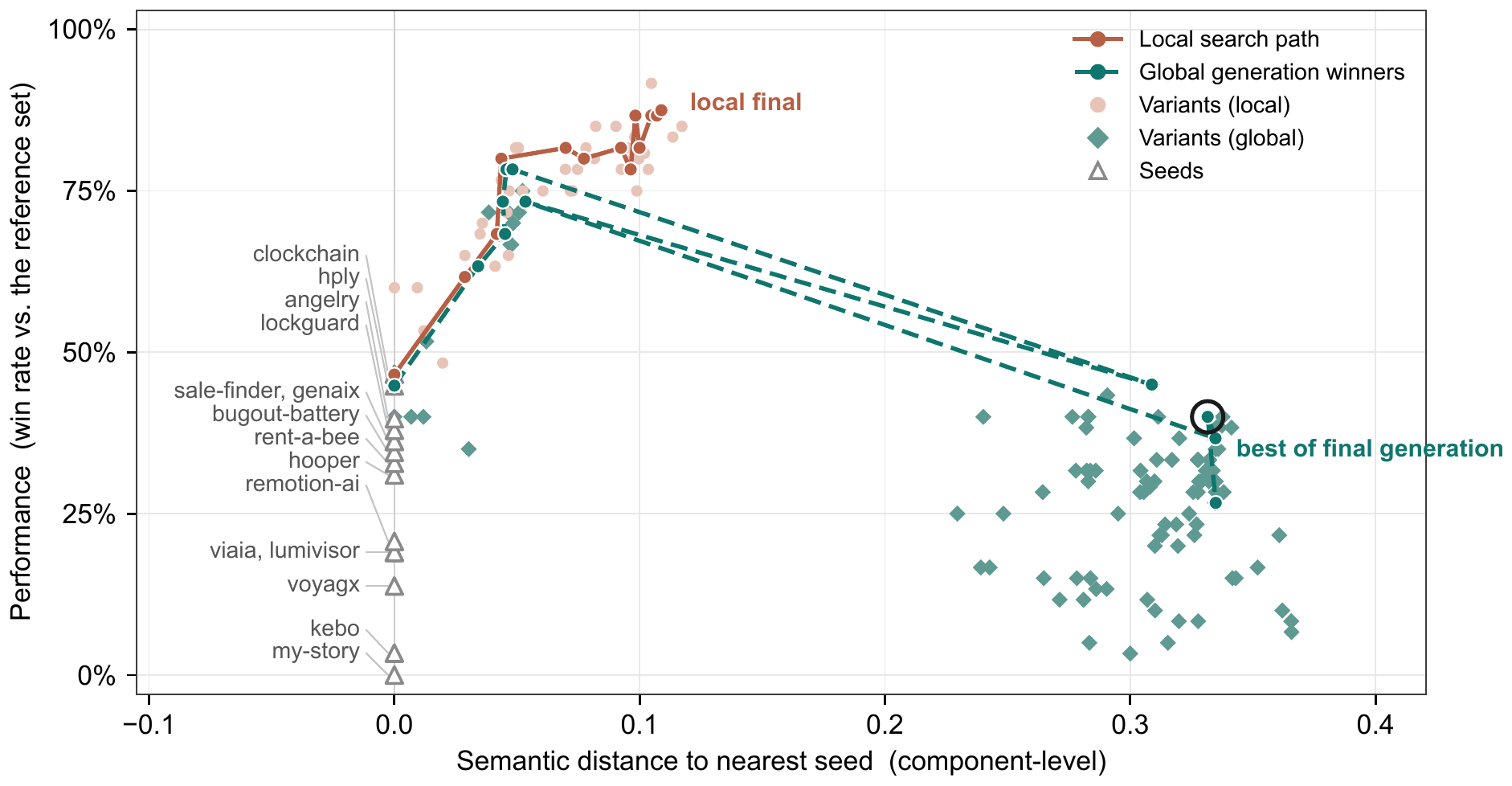
- Refinement develops an idea. Twelve rounds of local refinement lifted a file-authentication concept from sixteenth to third among thirty originals, chiefly by sharpening its design and evidence plan.
- Recombination opens different routes. Global search created concepts more distant from the starting ventures. Subsequent refinement improved all fifteen final concepts; the strongest outranked twenty-four originals. Local search alone earned higher scores but stayed closer to its starting points.
- Retention shapes discovery. The rule that preserved weak, novel combinations also discarded a variant with a 78% win rate. A concept’s value can lie in what it later contributes, not only in its current merit.
Why it matters
Shared AI could broaden the possibilities considered within firms while making those sets more alike across firms—a possibility the paper calls correlated imagination. Proprietary problems and evidence from each firm’s own experiments can send similar systems in different directions.
As ideas become cheaper to generate, entrepreneurial judgment extends to governing the search that produces them: what to explore, which possibilities to preserve, and when to seek evidence through action. Customer tests and implementation experience become scarce complements to abundant conjecture.
Abstract
Entrepreneurs cannot pursue ventures they never imagine. This article develops a generative view of entrepreneurial imagination as the construction of an evolving candidate set through generation, provisional evaluation, and revision. Conceptual search represents venture concepts as text, transforms them through interpretable operations, and compares their promise. A large language model prototype demonstrates complementary modes: local refinement lifts a concept from sixteenth to third among thirty ventures under a validated evaluator, while global recombination reaches distant possibilities that refinement makes competitive. The framework shows how search architecture determines what enters, survives, and develops, and how AI may broaden imagination within firms while producing correlated imagination across firms. By making imagination programmable, auditable, and experimentally tractable, conceptual search opens a research program on how entrepreneurial possibilities are constructed.
Other links
- Preprint copy: SSRN.
- Code, prompts, and complete search records on GitHub. The repository includes the records needed to rebuild every figure and number in the empirical section without new model calls.
- Blog post: Can AI come up with a good business plan?
- Join the discussion on LinkedIn
Last updated 2026-09-22